How to Add Time in Hours and Minutes (Simple Step-by-Step Guide)
Clocks refuse to play by decimal rules. Sixty minutes make an hour, not a hundred. That single quirk trips people up daily. Once you learn how to add time in hours and minutes, timesheets and travel plans stop feeling like puzzles. Here is the plain method.
What Is Time Addition?
Time addition means combining two or more time values into one total. You stack time units and carry the overflow. The math stays simple once you respect base 60.
First, separate time duration from clock time. Three hours forty minutes is a length. 3:40 PM is a moment. Adding time works on durations, so treat them differently.
How to Add Hours and Minutes Together
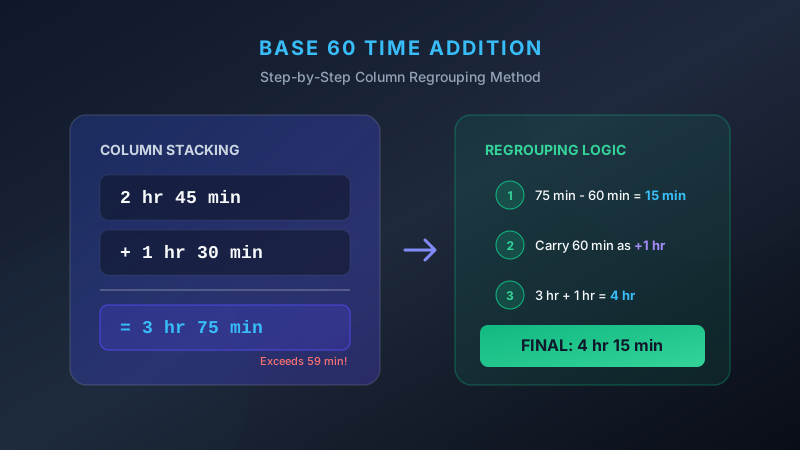
Here is the whole trick in three moves. Add minutes. Add hours. Carry any overflow. Think of it like dollars and cents kept in separate columns.
  2 hr  45 min
+  1 hr  30 min
-----------------
   3 hr  75 min  →  4 hr 15 min
That carry step is where most errors hide. Adding hours and minutes correctly means checking the minute column before you write your answer down.
How to Add Minutes When They Exceed 60
60 minutes equals one hour, so any total above 59 must be regrouped. Subtract 60 and add one hour. For example, 45 + 50 = 95 minutes, which becomes 1 hour 35 minutes. Large sums? Divide by 60 instead.
Converting Extra Minutes Into Hours
To convert minutes into hours, divide by 60. The whole number gives total hours. The remainder stays as minutes. So 200 minutes equals 3 hours 20 minutes.
American payroll uses decimals, though. Time conversion matters when you add work hours into payroll software.
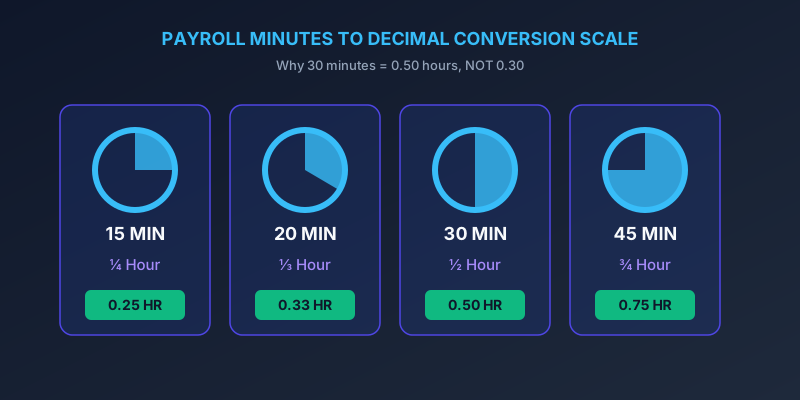
| Minutes | Fraction | Decimal |
|---|---|---|
| 15 | ¼ | 0.25 |
| 20 | ⅓ | 0.33 |
| 30 | ½ | 0.50 |
| 45 | ¾ | 0.75 |
Simple Examples of Adding Time
Try easy time addition examples first. 2 hr 15 min plus 1 hr 20 min gives 3 hr 35 min. No carrying needed there.
Now add 4 hr 50 min and 3 hr 25 min. Minutes total 75, so borrow one hour. The answer? 8 hr 15 min. That is adding time step by step.
How to Add Several Time Values
Need to add multiple time values? Total every minute first. Convert once at the end. Batching beats carrying at each stage.
“Group numbers that hit 60, like a cashier counting change.”, a shortcut worth stealing.
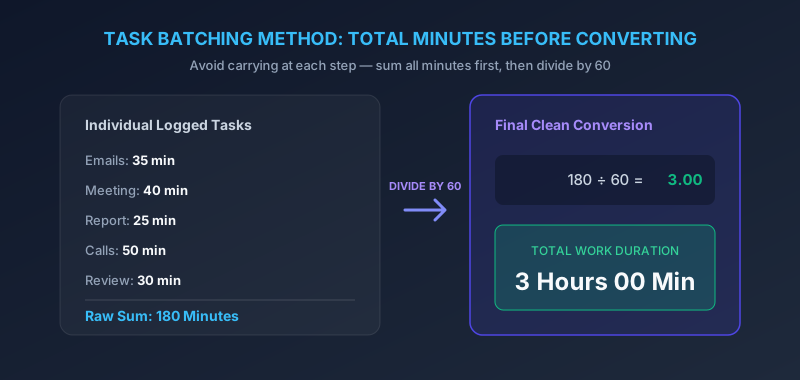
| Task | Minutes |
|---|---|
| Emails | 35 |
| Meeting | 40 |
| Report | 25 |
| Calls | 50 |
| Review | 30 |
| Total | 180 = 3 hours |
Adding Time for Everyday Activities
Real life demands this skill constantly. You calculate hours worked across a week. You sum flight legs plus layovers. You schedule a Thanksgiving oven down to the minute.
Watch midnight carefully. A shift from 9 PM to 5 AM crosses into a new day, so calculate elapsed time as eight hours, not four. Nurses and pilots learn this fast.
Common Time Addition Mistakes
The biggest trap is decimal confusion. Writing 1.30 does not mean 1 hour 30 minutes. It means 1 hour 18 minutes. That error costs employees real money.
Second, people forget the carry. Third, they mix 12 hour and 24 hour notation. Finally, midnight rollovers get ignored. Slow down and your time arithmetic stays clean.
When to Use a Time Addition Calculator
Manual math works beautifully for two or three entries. Beyond that, a time addition calculator saves your sanity. Long timesheets, billable client hours, and multi leg itineraries deserve a hours and minutes calculator.
Still, verify your inputs. A time calculator online cannot catch a wrong AM/PM entry. Federal wage rules expect accurate records, so double check every shift before submitting. Garbage in, garbage out.
Case Study: Maria’s Weekly Timesheet
Maria, a Denver barista, logged 7 hr 45 min, 6 hr 30 min, 8 hr 15 min, and 5 hr 50 min. Her minutes totaled 140, or 2 hr 20 min. Added to 26 hours, she worked 28 hr 20 min, 28.33 decimal hours.
Conclusion
Three moves solve everything: minutes, hours, carry. Practice mentally before reaching for an add time calculator. Your brain gets faster with repetition, honestly.
Master this and how to calculate total time stops being guesswork. Whether you add 30 minutes to a time or total a month of shifts, the logic holds. Now go add time in hours and minutes with confidence.