How to Add Time for Daily Schedules and Activities
Days vanish mysteriously. You stay busy from morning until night, yet nothing important seems finished. The fix starts with actual numbers, not willpower. Learning how to calculate daily time reveals exactly where your hours disappear. This guide walks through morning routines, study blocks, workouts, and hobbies, with real math you can copy tonight.
Why Time Addition Helps With Daily Planning
You cannot manage what you never measure. Totaling your daily activities exposes hidden time drains almost immediately, usually within three days of honest logging.
Most people guess badly about their own habits. Ask someone about their phone usage and they typically underestimate by half. Honest time tracking corrects that blind spot faster than any productivity advice ever could.
How to Total Time Spent on Daily Activities
List every activity alongside its activity duration. Then calculate total time spent by summing all minutes and converting once at the end.
Round to five minute blocks for your own sanity. Precision beyond that rarely changes any decision you make about your daily routine. Perfect data collected for two days beats rough data collected for zero.
Adding Morning Routine Activities
Mornings hide surprising bulk. Shower, dressing, breakfast, and commute stack up faster than anyone expects.
| Activity | Duration |
|---|---|
| Shower | 15m |
| Dressing | 10m |
| Breakfast | 20m |
| Commute | 35m |
| Total | 1h 20m |
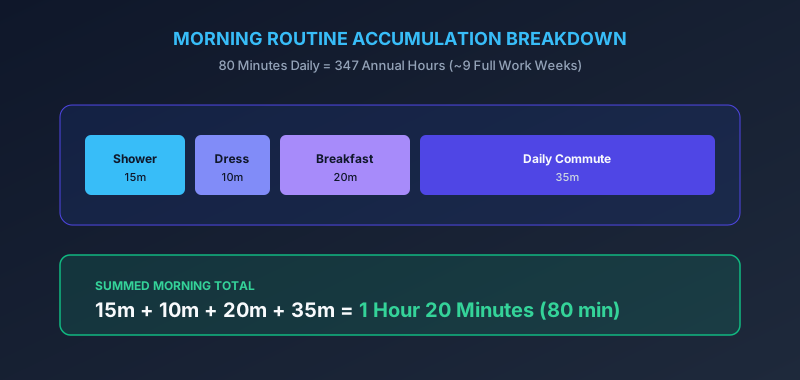
Sequentially stacking morning habits demonstrates how quickly minutes compound before work
Those eighty minutes repeat every weekday. Across a working year, that equals roughly 347 hours, or nearly nine full work weeks spent simply getting started.
Calculating Study and Work Time
To add study hours and add work hours, log each focused block separately rather than as one lump. Three sessions of 50, 45, and 40 minutes total 135 minutes, converting to 2 hours 15 minutes. Breaks between blocks never count as study time.
Adding Exercise and Leisure Time
To calculate exercise time, include warmup and cooldown honestly. A 40 minute run plus 15 minutes of stretching equals 55 minutes, not 40.
Leisure deserves counting equally. Streaming, scrolling, and gaming all consume genuine time allocation worth knowing about. Counting them is not judgment, just information you can act on later.
How to Calculate Total Daily Activity Time
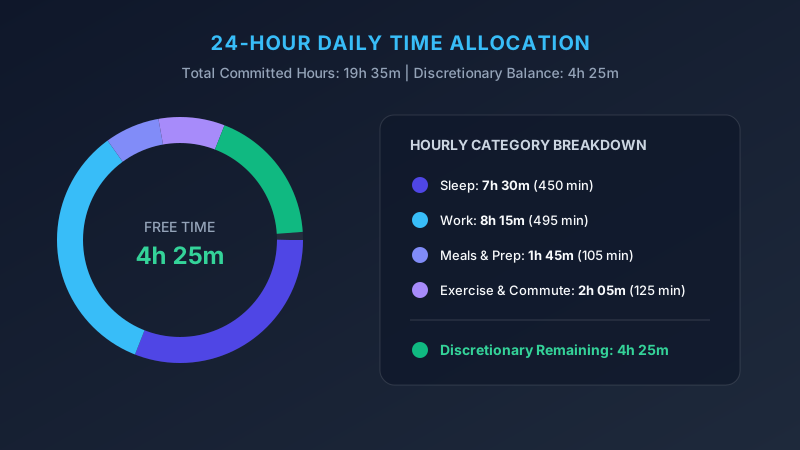
Add every category together, then compare against 24 hours. Whatever remains represents your actual discretionary time.
| Category | Duration |
|---|---|
| Sleep | 7h 30m |
| Work | 8h 15m |
| Meals | 1h 45m |
| Exercise | 55m |
| Commute | 1h 10m |
| Total | 19h 35m |
Comparing fixed commitments against total day length unlocks intentional discretionary time
That leaves 4 hours 25 minutes completely unaccounted for. Where exactly does yours go each evening?
Planning a Day With Time Durations
Build tomorrow backward from your hardest deadline. Assign each task a realistic duration, then add multiple activities together before committing.
“Plan in minutes, not vibes.”
If your planned blocks exceed available hours, cut something deliberately right now. Choosing beforehand always feels better than failing afterward and apologizing.
Tracking Time Spent on Hobbies
Hobbies get squeezed out first whenever schedules tighten. Calculate time spent on hobbies honestly and the result may genuinely surprise you.
Thirty minutes daily on guitar equals 182 hours annually. That is enough practice to reach solid intermediate skill. Consistency compounds far more powerfully than occasional long sessions.
Using a Time Addition Calculator for Scheduling
An online time addition calculator handles long activity lists instantly. Enter durations, read your total, then adjust the plan while it still matters.
Weekly reviews work best in practice. A daily time calculator transforms vague feelings of busyness into concrete evidence you can actually act upon with confidence.
Case Study: Tom’s Hidden Hours
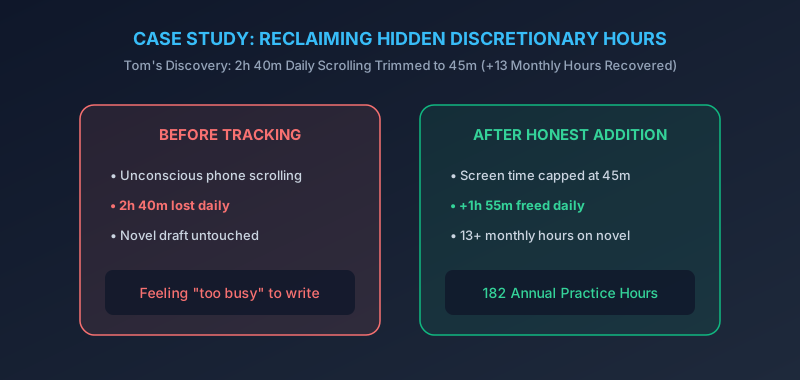
Tom, a Portland teacher, tracked seven full days without changing anything first. His logged total daily activity time showed 2 hours 40 minutes of daily scrolling. He trimmed it to 45 minutes and gained roughly 13 hours monthly, which he redirected into his long delayed novel draft.
Conclusion
Now you can calculate daily hours and see precisely where your day actually goes. Log honestly, add carefully, convert once, then compare against reality.
Start with three days of tracking before changing anything. The numbers speak clearly on their own, and small adjustments compound into genuinely different years.