How to Add Hours, Minutes, and Seconds (Step-by-Step Guide)
Three units, one answer. That is the whole puzzle. Seconds roll into minutes, minutes roll into hours, and everything cascades upward in a chain. Learning how to add hours minutes and seconds takes roughly five minutes of practice. Afterward, stopwatch splits, cooking timers, and shift totals stop confusing you permanently. Here is the complete method, explained in plain language.
Understanding Hours, Minutes, and Seconds
Time runs on base 60, not base 10. Sixty seconds build one minute. Sixty minutes build one hour. Ancient Babylonian astronomers chose this system thousands of years ago, and nobody ever successfully replaced it.
That history matters for your time addition today. You cannot simply stack numbers the way you stack dollars. Each column carries a hard ceiling at 59. Cross it and something must move upward.
How to Add Hours Together
Hours behave like ordinary numbers, thankfully. Just add them straight across. Four plus three equals seven, exactly as you expect.
The twist arrives from below. Your minutes column may send an extra hour climbing upward at the last moment. So always finish the smaller units before locking in your total time. Rushing the hours column first is the fastest route to a wrong answer.
How to Add Minutes Together
Sum every minute value first, ignoring the 60 ceiling entirely. Write the raw number down even if it looks ridiculous. One hundred forty minutes is perfectly fine as a temporary figure.
Then check it against 60. Anything at 60 or above needs regrouping into hours. This single habit prevents the overwhelming majority of time calculation mistakes people make on paper.
How to Add Seconds Together
Seconds work identically to minutes. Add seconds into one raw total, then regroup upward. For example, 45 plus 38 gives 83 seconds. Subtract 60, carry one minute, and 23 seconds remain. Always start here when you add hours minutes seconds together, never at the top.
Converting 60 Seconds Into a Minute
60 seconds to one minute is the foundational rule. To convert seconds into minutes, divide your total by 60. The whole number becomes minutes. Whatever remains stays as seconds.
So 200 seconds equals 3 minutes 20 seconds. Verify it quickly: three times 60 makes 180, leaving exactly 20 behind. That verification habit catches errors before they spread into your hours column.
Converting 60 Minutes Into an Hour
60 minutes to one hour follows the same pattern, one level higher. To convert minutes into hours, divide the minute total by 60 again.
Try 260 minutes. Divided by 60, that gives 4 with 20 remaining. Your answer reads 4 hours 20 minutes. Notice how the method never changes, only the unit names do.

| Raw Amount | Converts To |
|---|---|
| 90 seconds | 1 min 30 sec |
| 150 seconds | 2 min 30 sec |
| 245 seconds | 4 min 5 sec |
| 90 minutes | 1 hr 30 min |
| 195 minutes | 3 hr 15 min |
| 380 minutes | 6 hr 20 min |
How to Carry Extra Seconds
To carry seconds when adding time, subtract 60 and add one minute upward. Repeat the subtraction if your total is genuinely large, or simply divide once.
Here sits the classic trap. That carried minute must join your minute column before you convert the minutes. Miss this step and your final answer drifts by a full hour. Circle carried values on your page as insurance.
How to Carry Extra Minutes
Now carry minutes when adding time using the identical method. Subtract 60 from the minutes, add one to the hours.
Work strictly bottom to top, always. Seconds first, then minutes, then hours last. This order keeps the cascade honest and prevents you from finalizing a column that still needs a carry.
“Add upward, carry upward. The clock never works sideways.”
Examples of Adding Hours, Minutes, and Seconds
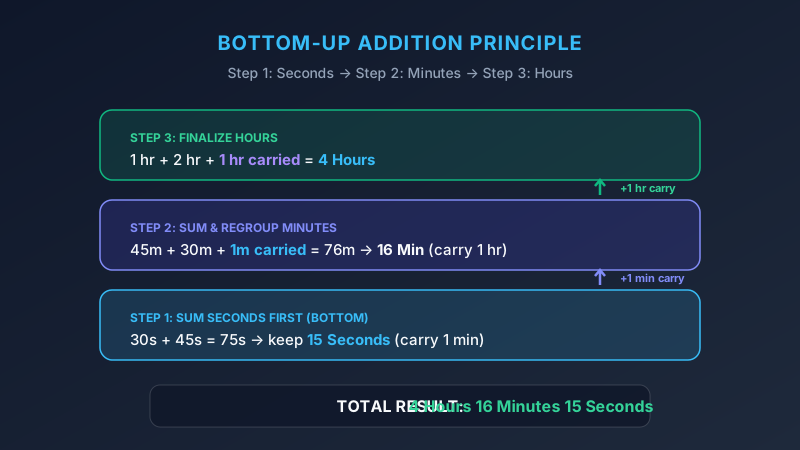
Try these time addition examples yourself. Add 1h 45m 30s and 2h 30m 45s. The seconds give 75, so carry one minute and keep 15 seconds.
Minutes now total 76, which becomes 1 hour and 16 minutes. Hours reach 4 including the carry. Final answer: 4 hours 16 minutes 15 seconds.
| Step | Working |
|---|---|
| Seconds | 30 + 45 = 75 → 1m 15s |
| Minutes | 45 + 30 + 1 = 76 → 1h 16m |
| Hours | 1 + 2 + 1 = 4 |
| Total | 4h 16m 15s |
Case Study: Sarah’s Marathon Splits
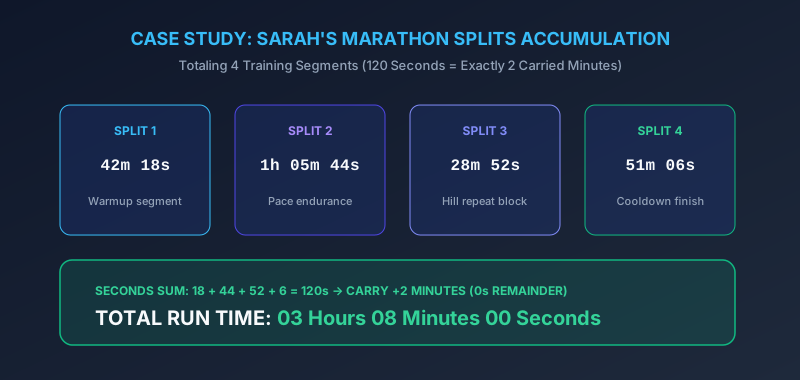
Sarah, a Boston runner, tracked four training segments during one long session: 42m 18s, 1h 5m 44s, 28m 52s, and 51m 6s. Her seconds totaled 120, adding two clean minutes with nothing remaining. Her final total duration landed at exactly 3 hours 8 minutes, matching her target race pace almost perfectly.
Conclusion
You can now calculate total seconds, minutes, and hours with real confidence. The method never varies. Sum each column raw, divide by 60, then carry the whole numbers upward.
Practice adding time step by step on paper once or twice this week. Then use an online time addition calculator for genuinely long lists. Knowing both approaches keeps you fast and keeps you accurate.