What Is the Difference Between Time Addition and Time Duration?
People confuse these two constantly. Both involve clocks, both involve numbers, yet each answers a completely different question. Understanding the difference between time and duration eliminates roughly half of all scheduling mistakes. This guide explains both concepts in plain language, with worked examples you can apply immediately to shifts, flights, and meetings.
What Does Time Addition Mean?
Time addition means combining lengths into a single total. You stack durations and sum them together. The answer is always a length, never a clock reading.
It also describes adding a length onto a moment. Start at 2:15 PM, add 90 minutes, and you finish at 3:45 PM. Same operation, different flavor. Both count as time arithmetic in everyday use.
What Is a Time Duration?
A time duration measures how long something lasted. Three hours twenty minutes. Forty five seconds. Six days. No starting point required whatsoever.
Durations answer the question “how long?” They travel freely between contexts without losing meaning. A two hour movie stays two hours whether it starts at noon or at midnight in another time zone entirely.
Time vs. Duration Explained
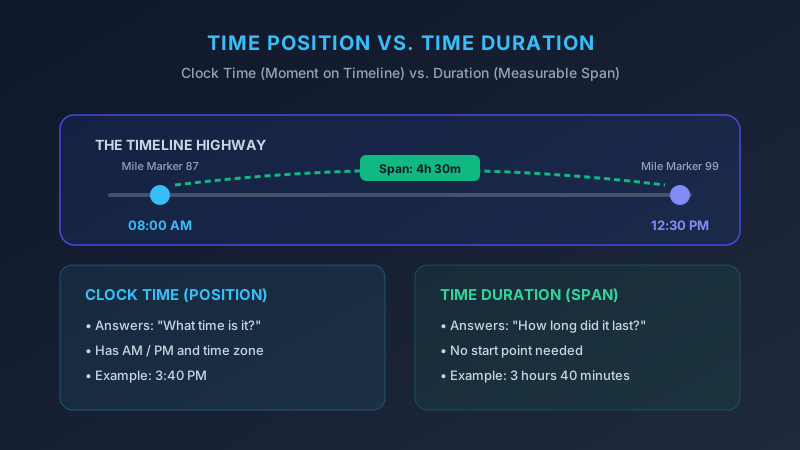
Clock time marks a position on a timeline. Duration measures a span along it. That difference captures the entire time addition vs duration distinction in one sentence.
Picture a highway. Mile marker 87 tells you where you are sitting. Twelve miles driven tells you how far you traveled. Both use numbers comfortably, yet swapping them produces total nonsense.
How to Add a Duration to a Starting Time
To add duration to starting time, handle minutes first, then hours. Start at 9:45 AM and add 2h 30m. Minutes reach 75, so carry one hour upward. You find ending time from duration at 12:15 PM. Watch AM and PM transitions carefully here.
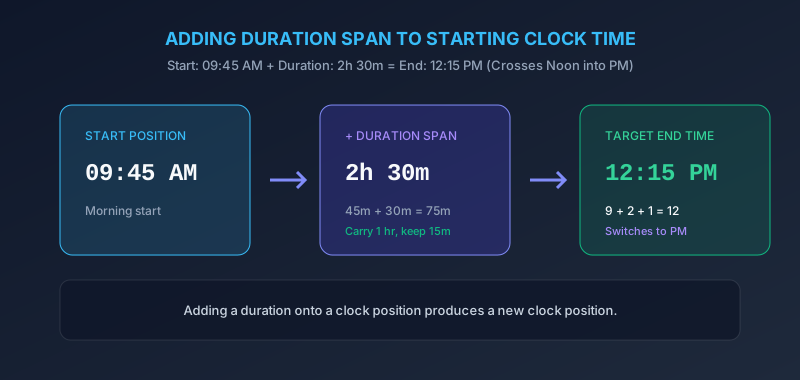
Adding a duration span onto a starting clock position to derive an exact end time
How to Calculate Total Duration
To calculate total duration, subtract your start time from your end time. Running 8:20 AM to 4:05 PM gives 7 hours 45 minutes.
Borrowing helps whenever the minutes look negative. Take one hour from the hours column, add 60 minutes to the minute column, then subtract normally. It mirrors ordinary borrowed subtraction exactly.
| Start | End | Duration |
|---|---|---|
| 8:00 AM | 12:30 PM | 4h 30m |
| 9:45 AM | 5:15 PM | 7h 30m |
| 10:00 PM | 6:00 AM | 8h 0m |
| 11:30 AM | 3:05 PM | 3h 35m |
Examples of Time Addition
Here are clear time calculation examples. Add 1h 50m and 2h 25m to reach 4 hours 15 minutes. That is pure duration addition, with no clock involved anywhere.
Now mix the types deliberately. A meeting starting 3:30 PM and running 90 minutes ends at 5:00 PM. You added a span onto a position and received a new position.
Examples of Duration Calculation
Duration calculation examples always begin with two clock readings. A flight departing 7:20 AM and landing 11:05 AM covers 3 hours 45 minutes of elapsed time.
Overnight spans demand extra care. To calculate elapsed hours from 11 PM to 7 AM, count forward to midnight, then continue into the next day. Eight hours total, not four.
“Midnight resets the clock, not the stopwatch.”
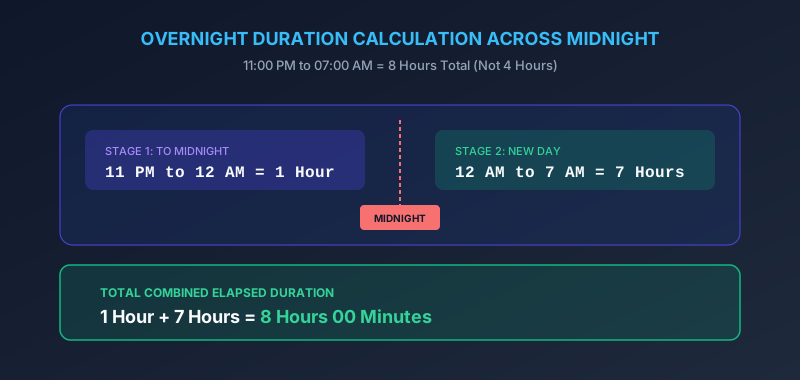
Calculating overnight shifts across midnight by splitting into pre midnight and post midnight segments
Common Confusion Between Time and Duration
The classic error reads 4:30 as four and a half hours. Usually it means half past four in the afternoon. Context decides, and context often goes unstated.
Another trap involves plain subtraction. You cannot subtract 2:45 PM from 6:00 PM on a standard calculator and expect sense. Time arithmetic needs base 60 throughout, which decimal machines simply do not provide.
Choosing the Right Time Calculator
Pick your tool based on the question asked. Adding lengths together? Use a duration calculator. Finding the gap between two clock readings? Use a time difference calculator instead.
Some tools handle both modes cleanly. An online time calculator with clearly separated modes prevents mismatched answers entirely, which matters when invoices depend on the output.
Case Study: Two Answers, One Shift
Elena clocked in at 7:15 AM and out at 3:45 PM. Her elapsed time ran 8 hours 30 minutes, calculated by subtraction. Later she added a 45 minute second shift, reaching 9 hours 15 minutes total. The first number came from duration calculation, the second from time addition. Same day, two entirely different operations.
Conclusion
Now you understand what is time addition and what is time duration, plus exactly why confusing them creates expensive errors. Positions differ fundamentally from spans.
Ask yourself one question before calculating anything. Do you want “how long?” or “what time?” The correct tool and method follow automatically from that single answer.